Helicobacter pylori: a persistent carcinogenic threat amid a growing gastric cancer burden
Helicobacter pylori, classified as a Group 1 carcinogen¹ by the World Health Organization, is the leading cause of gastric cancer, a disease associated with high morbidity and a frequently poor prognosis. Yet this chronic infection is largely preventable or treatable, making it a key target for cancer prevention worldwide.
Alarming projections: more than 15 million expected cases
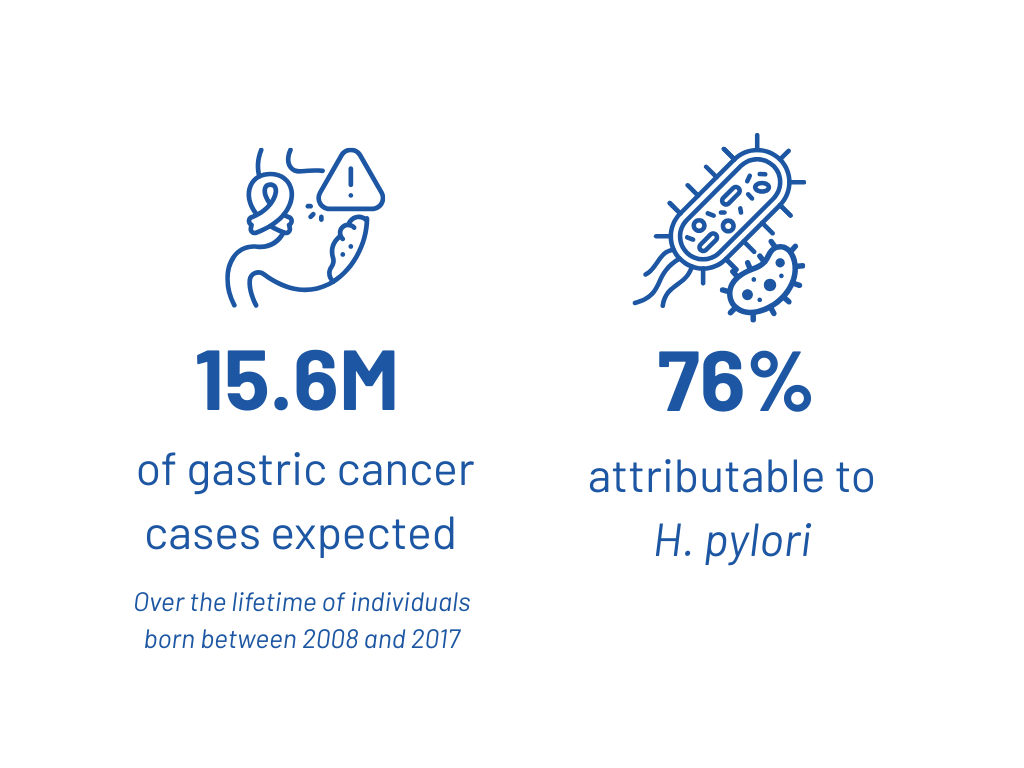
An international study published in Nature Medicine modelled the future burden of gastric cancer across 185 countries. By combining national incidence data (GLOBOCAN 2022) with United Nations demographic projections, the authors estimated that, in the absence of new prevention measures, 15.6 million gastric cancer cases are expected to occur over the lifetime of individuals born between 2008 and 2017.
Among these projected cases, nearly 76% are attributable to H. pylori and are therefore potentially preventable if effective screening and eradication strategies are implemented.²
The projections further show that:
- Two-thirds of cases will occur in Asia, representing more than 10.6 million, far exceeding other regions.
- The Americas (~2 million) and Africa (~1.7 million) rank second and third, respectively.
Even in traditionally low-incidence regions, the burden is expected to rise due to population growth and ageing.
These figures highlight a major public health challenge, particularly in Asian countries where H. pylori prevalence remains high and large-scale screening and treatment programmes are not yet widely implemented.²
Deeplex® HelP: an innovative tool to advance gastric cancer prevention
In light of these projections, improving the effectiveness of H. pylori eradication strategies has become a priority, particularly in regions with high prevalence and rising antibiotic resistance.
Developed by GenoScreen, Deeplex® HelP is a culture-free, targeted deep sequencing assay designed for the comprehensive molecular profiling of H. pylori directly from clinical specimens.
The assay enables H. pylori strain typing, genotyping of major virulence factors, and prediction of antibiotic resistance without the need for bacterial culture.
By providing detailed genomic information on circulating strains, it supports informed treatment decisions and helps reduce the risk of eradication failure. In addition, characterisation of strain-specific virulence factors may offer further insights into infection risk profiles and contribute to the development of more individualised management strategies.
Deeplex® HelP enables more precise infection management and facilitates informed treatment decisions, contributing to long-term strategies aimed at reducing the burden of gastric cancer associated with H. pylori.
Sources:
- IARC Helicobacter pylori Working Group (2014). Helicobacter pylori eradication as a strategy for preventing gastric cancer. IARC Working Group Reports, No. 8. International Agency for Research on Cancer / World Health Organization
- Park JY, Georges D, Alberts CJ, Bray F, Clifford G & Baussano I (2025). Global lifetime estimates of expected and preventable gastric cancers across 185 countries. Nature Medicine, published online 7 July 2025; DOI: 10.1038/s41591-025-03793-6. Report featured on the International Agency for Research on Cancer (IARC) News.