
Deeplex® Myc-TB
Advanced Diagnostic Test
for Tuberculosis Infections and Antibiotic Resistance
Desarrollado por GenoScreen
Get a FREE tailored demonstration based on your needs.
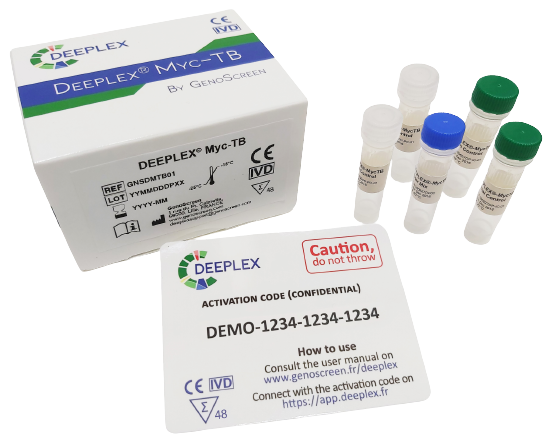
La solución todo en uno para la detección exhaustiva de la farmacorresistencia de Mycobacterium tuberculosis
Deeplex Myc-TB es , desarrollado por GenoScreen, es una solución de pruebas de resistencia a fármacos para la tuberculosis basada en NGS. Además, es un kit de diagnóstico innovador e integrado sin cultivo, que proporciona resultados moleculares sobre la resistencia o susceptibilidad a 15 fármacos antituberculosos en menos de 48 horas. El ensayo se basa en la secuenciación profunda dirigida y el análisis automatizado de datos a través de la aplicación web segura Deeplex Myc-TB.
Además, nuestro producto puede detectar tuberculosis heterorresistencia hasta el 1-3%, y también identifica Mycobacterium tuberculosis y espoligotipos, así como más de 100 especies de micobacterias no tuberculosas (MNT).
Al proporcionar una predicción rápida y exhaustiva de la resistencia genética a los fármacos antituberculosos, esta innovadora prueba representa una poderosa herramienta para guiar el tratamiento terapéutico eficaz de los pacientes que padecen tuberculosis. Por lo tanto, las pruebas de resistencia a fármacos para la tuberculosis basadas en NGS proporcionadas por Deeplex Myc-TB permiten a los clínicos detectar tanto la resistencia a fármacos de primera como de segunda línea.
15
medicamentos antituberculosos
pantalla
48h
de las muestras clínicas a los resultados
1-3%
sensibilidad de detección de heterorresistencia
>100
micobacterias
especies identificadas
Componentes clave de
Deeplex Myc-TB
- A Deeplex Master Mix: una única mezcla de PCR de 24 complejos para la amplificación sin cultivo de 18 dianas génicas asociadas a la farmacorresistencia de Mycobacterium tuberculosis combinada con dianas para la identificación de especies micobacterianas y el genotipado de cepas MTBC.
- Un control interno para el control de calidad en la muestra.
- Un control positivo para la validación de la prueba.
- Un código de activación para acceder a la aplicación web Deeplex Myc-TB.
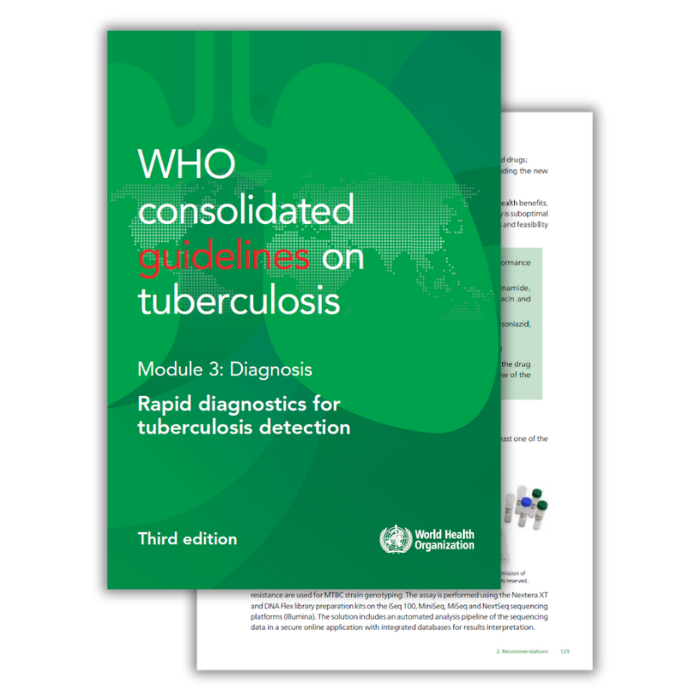
Directrices consolidadas de la OMS sobre la tuberculosis
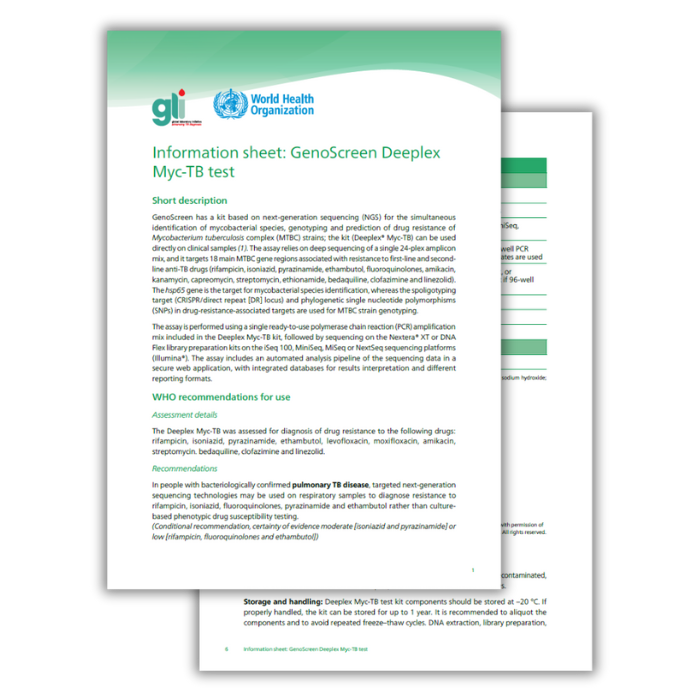
Hoja informativa GenoScreen: Prueba Deeplex Myc-TB
The World Health Organization (WHO) has recently updated its “Consolidated Guidelines on Tuberculosis“, recommending targeted next-generation sequencing (tNGS) as a preferred method for diagnosing drug-resistant tuberculosis (DR-TB). In particular this new guidance underscores the critical role of advanced diagnostics in quickly identifying drug resistance patterns, thereby helping clinicians make informed decisions and ultimately improving patient outcomes.
Esta prueba de resistencia a fármacos para la tuberculosis basada en NGS ha sido evaluada y aprobada por la OMS por su precisión y eficacia.
En particular, Deeplex Myc-TB ha sido destacado por la OMS como el único ensayo tNGS que cumple los criterios de rendimiento para los 10 fármacos evaluados, lo que lo convierte en la solución más eficaz para el diagnóstico de la DR-TB. Además, al adoptar Deeplex Myc-TB, los proveedores de atención sanitaria tienen acceso a la herramienta basada en tNGS más avanzada, lo que permite realizar diagnósticos más rápidos y exhaustivos en consonancia con las recomendaciones de la OMS.
Descargar la nota técnica
La tuberculosis, un reto de salud pública mundial
Tubérculoculosis (TB) es una de las enfermedades infecciosas más mortíferas del mundo, con 10 millones de nuevos casos anuales, que provocan cerca de 1,5 millones de muertes al año.
Esta enfermedad contagiosa se desarrolla principalmente en los pulmones, pero también puede afectar a otras muchas partes del cuerpo. Está causada por bacterias que forman parte del complejoMycobacterium tuberculosis (MTBC). El tratamiento de la tuberculosis activa requiere la toma de una combinación de múltiples antibióticos durante 6 meses o más.
La tuberculosis farmacorresistente, una amenaza creciente
En Organización Mundial de la Salud (OMS) estimó que en 2021 se produjeron unos 450.000 nuevos casos de tuberculosis multirresistente (MDR) o resistente a la rifampicina, de los cuales ~6% eran tuberculosis extremadamente resistente a los medicamentos (XDR-TB, resistencia adicional a al menos un medicamento adicional del grupo A).
Cuando la cepa de MTBC que infecta al paciente es resistente a los fármacos que forman parte del régimen de tratamiento, la terapia no tendrá éxito. Además, la farmacorresistencia también puede amplificarse cuando no se detecta una resistencia preexistente. Así pues, la detección rápida, precisa y exhaustiva de la susceptibilidad a los fármacos y la farmacorresistencia es crucial para el tratamiento eficaz de los pacientes y para prevenir el desarrollo ulterior de farmacorresistencia y la transmisión de la tuberculosis.

Nuestras referencias
2026
False detection of rifampicin resistance using Xpert MTB/RIF Ultra due to a P454L mutation on rpob in Mycobacterium tuberculosis: a case report
Genestet, C. et al.
Mycobacteria 2
2026
Targeted next-generation sequencing implementation in Eswatini identifies rifampicin and bedaquiline resistance undetected by routine diagnostic testing
Vambe D. et al.
Nature communications
2026
Discordant rifampicin resistance results in repeat Xpert MTB/RIF testing: Risk factors and diagnostic challenges among drug-resistant tuberculosis patients in Bangladesh
Uddin MKM. et al.
Journal of global antimicrobial resistance
2026
Breaking barriers in extensively drug-resistant TB: pretomanid-centred long regimen achieves cure in a bedaquiline-resistant strain
Schiuma, M. et al.
IJTLD Open
2026
Leveraging rpoB amplicon signals from Xpert MTB/RIF ultra as a diagnostic opportunity for identifying Non-tuberculous mycobacteria in TB-negative specimens
Rupa, A. A. et al.
Nature – Scientific reports
2026
Evaluation of the deeplex Myc-TB-targeted next-generation sequencing assay for mycobacterial identification and drug resistance detection
Notarte, K. I. et al.
Journal of clinical microbiology
2026
Targeted next-generation sequencing for direct drug-resistant tuberculosis detection in sputum samples in Indonesia: an implementation study (2024-25)
Lestari, B. W. et al.
The Lancet regional health
2026
Performance of a targeted next generation sequencing assay for mycobacterial identification and drug resistance from sputum and isolates
Kuss-Duerkop, S. K. et al.
Journal of clinical microbiology
2026
Targeted Next-Generation Sequencing in Drug-Resistant Tuberculosis: WHO Guidance and Practical Implementation Priorities
Jung S. et al.
Biomedicines
2026
Pilot evaluation of a compact targeted next-generation sequencing with minimum biocontainment for rapid diagnosis of drug-resistant tuberculosis
Gopalaswamy , R. et al.
Mycrobiology spectrum
2026
Cost-Effectiveness of Targeted Next-Generation Sequencing for Diagnosing Pre-XDR and XDR Tuberculosis in Rifampicin-Resistant Patients Across High-Burden Settings
Fekadu, G. et al.
Science direct – Archivos de bronconeumologia
2026
Use of reverse dot blot hybridization DNA-array and targeted next-generation sequencing for the detection of drug resistance in patients with tuberculosis: a prospective diagnostic accuracy study
Dudnyk , A. et al.
European journal of clinical microbiology & infectious diseases
2025
Characterization of Drug Resistance Mutations in Mycobacterium tuberculosis Isolates from Moroccan Patients Using Deeplex Targeted Next-Generation Sequencing
Laatri, S. et al.
Mycroorganisms
2025
Targeted next-generation sequencing for drug-resistant tuberculosis diagnosis: implementation considerations for bacterial load, regimen selection and diagnostic algorithm placement
Georghiou, S. B. et al.
BMJ global health
2025
Detection of I491F and V170F rpoB mutations associated with misdiagnosis of rifampicin resistance among patients with drug-susceptible tuberculosis treatment failure, Myanmar, 2022
Ei , P. W. et al.
Journal of global antimicrobial resistance
2025
Diagnostics, resistance and clinical relevance of non-tuberculous mycobacteria unidentified at the species level by line probe assays: a bi-national study
Dohál, M. et al.
Annals of clinical microbiology and antimicrobials
2025
Cost-effectiveness of Targeted Next-Generation Sequencing for Tuberculosis Drug-resistance Testing as an Alternative to the Standard of Care in South Africa
de Nooy, A. et al.
Clinical infectious diseases : an official publication of the Infectious Diseases Society of America
2025
Evaluating culture-free targeted next-generation sequencing for diagnosing drug-resistant tuberculosis: a multicentre clinical study of two end-to-end commercial workflows
Colman, R. E. et al.
The Lancet. Infectious diseases
2025
Comparative assessment of line probe assays and targeted next-generation sequencing in drug-resistant tuberculosis diagnosis
Carpi , G. et al.
EBioMedicine
2024
Targeted sequencing from cerebrospinal fluid for rapid identification of drug-resistant tuberculous meningitis
Tram, T. T. B. et al.
Journal of clinical microbiology
2024
Mixed nontuberculous mycobacteria in an immunocompromised patient with probable progressive multifocal leukoencephalopathy
Opperman, C. et al.
Journal of clinical microbiology
2024
Nanopore-based targeted sequencing test for direct tuberculosis identification, genotyping, and detection of drug resistance mutations: a side-by-side comparison of targeted next-generation sequencing technologies
Cabibbe, A. M. et al.
Journal of clinical microbiology
2023
A smooth tubercle bacillus from Ethiopia phylogenetically close to the Mycobacterium tuberculosis complex
Yenew, B. et al.
Nature communications
2023
Bedaquiline- and clofazimine- selected Mycobacterium tuberculosis mutants: further insights on resistance driven largely by Rv0678
Snobre, J. et al.
Scientific reports
2023
Clinical utility of target-based next-generation sequencing for drug-resistant TB
Mansoor, H. et al.
The international journal of tuberculosis and lung disease
2023
Operationalising targeted next-generation sequencing for routine diagnosis of drug-resistant TB
Iyer, A. et al.
Public health action
2023
Clinical implications of molecular drug resistance testing for Mycobacterium tuberculosis: a 2023 TBnet/RESIST-TB consensus statement
Domínguez, J. et al.
The Lancet. Infectious diseases
2023
Implementation of targeted next-generation sequencing for the diagnosis of drug-resistant tuberculosis in low-resource settings: a programmatic model, challenges, and initial outcomes
de Araujo, L. et al.
Frontiers in public health
2023
Mycobacterium abscessus subspecies identification using the Deeplex Myc-TB targeted NGS assay
Buckwalter, S. P. et al.
Journal of clinical microbiology
2022
Safety, effectiveness, and adherence of a short and all-oral treatment regimen for the treatment of rifampicin-resistant tuberculosis in Niger: a study protocol of a pragmatic randomised clinical trial with stratified block randomisation
Souleymane, M. B. et al.
Trials
2022
Diagnóstico molecular rápido de la resistencia a la tuberculosis mediante secuenciación dirigida de heces
Sibandze, D. B. et al.
Genome medicine
2021
Targeted sequencing from cerebrospinal fluid for rapid identification of drug-resistant tuberculous meningitis
Mesfin, A. B. et al.
The international journal of tuberculosis and lung disease : the official journal of the International Union against Tuberculosis and Lung Disease
2021
Secuenciación dirigida de nueva generación directamente a partir de esputo para obtener información genética exhaustiva sobre Mycobacterium tuberculosis resistente a fármacos.
Kambli , P. et al.
Tuberculosis
2021
Secuenciación profunda de amplicones para la predicción sin cultivo de la susceptibilidad o resistencia a 13 fármacos antituberculosos
Jouet, A. et al.
The European respiratory journal
2021
Rapid genomic first- and second-line drug resistance prediction from clinical Mycobacterium tuberculosis specimens using Deeplex-MycTB
Feuerriegel, S. et al.
The European respiratory journal
2021
A Comprehensive Evaluation of GeneLEAD VIII DNA Platform Combined to Deeplex Myc-TB® Assay to Detect in 8 Days Drug Resistance to 13 Antituberculous Drugs and Transmission of Mycobacterium tuberculosis Complex Directly From Clinical Samples
Bonnet, I. et al.
Frontiers in cellular and infection microbiology
2020
Prevalence and drivers of false-positive rifampicin-resistant Xpert MTB/RIF results: a prospective observational study in Rwanda
Ngabonziza, J. C. S. et al.
The Lancet
2020
Descubierto un linaje hermano del complejo Mycobacterium tuberculosis en la región africana de los Grandes Lagos
Ngabonziza, J. C. S. et al.
Nature communications
2020
Targeted next-generation sequencing of sputum for diagnosis of drug-resistant TB: results of a national survey in Democratic Republic of the Congo
Kayomo , M. K. et al.
Scientific reports
2020
Zoonotic tuberculosis in humans assessed by next-generation sequencing: an 18-month nationwide study in Lebanon
El Achkar, S. et al.
The European respiratory journal
2019
Application of Targeted Next-Generation Sequencing Assay on a Portable Sequencing Platform for Culture-Free Detection of Drug-Resistant Tuberculosis from Clinical Samples
Cabibbe, A. M. et al.
Journal of clinical microbiology
2019
How Well Do Routine Molecular Diagnostics Detect Rifampin Heteroresistance in Mycobacterium tuberculosis?
Ng, K. C. S. et al.
Journal of clinical microbiology
2019
Drug-Resistant Tuberculosis, Lebanon, 2016 – 2017
El Achkar, S. et al.
Emerging infectious diseases
2018
Outbreak of multidrug-resistant tuberculosis in South Africa undetected by WHO-endorsed commercial tests: an observational study
Makhado, N. A. et al.
The Lancet
2017
Culture and Next-generation sequencing-based drug susceptibility testing unveil high levels of drug-resistant-TB in Djibouti: results from the first national survey
Tagliani, E. et al.
Scientific reports
Press releases
2025
GenoScreen and Clear Labs Announce the Launch of Clear Dx™ Deeplex® Myc-TB, an Automated Genomic Solution for Mycobacterium Characterization and TB Drug Resistance Detection
2022
Illumina and GenoScreen Partner to Expand Access to Genomic Testing for Multidrug-Resistant Tuberculosis